


By Dr. Margaret Bredehoft
For decades, traditional mammography has been the foundation of breast cancer screening. It has saved lives, reduced mortality, and remains a cornerstone of breast cancer screening in public health practice.
However, for a large segment of women, particularly those with dense breast tissue, mammography alone may not consistently provide sufficient diagnostic clarity.
Dense breast tissue is both one of the most common risk factors for breast cancer and one of the most significant limitations of mammographic imaging. Approximately 40% of women in their 50s and 25% of women aged 60 and older have dense breasts.
For some populations, the numbers are even higher. CDC-cited research shows that about 66% of Asian women in the United States have dense breast tissue.
Despite its prevalence and the fact that it both increases cancer risk and reduces mammographic sensitivity, dense breast tissue continues to be treated as a secondary detail rather than a central consideration in screening.
That disconnect has real consequences for screening effectiveness, diagnostic timelines, and equity in breast cancer outcomes.
The central question is whether current breast imaging pathways adequately serve the populations most likely to experience diagnostic uncertainty.
Why dense breast tissue changes the equation
Breast density refers to the proportion of fibroglandular tissue relative to fatty tissue visible on mammographic imaging. On imaging, both dense tissue and tumors appear white, while fatty tissue appears dark.
In women with dense breasts, the “white-on-white” effect can obscure malignancies. This creates two clinically important challenges:
Cancer risk is higher.
Cancer detection is more challenging.
In standard mammography, sensitivity decreases as breast density increases. As a result, small cancers may be obscured or indeterminate, some patients may be called back for additional testing, and some patients may enter extended surveillance periods.
In the United States, about 10% of screening mammograms result in a callback for additional imaging. Women with dense breasts are twice as likely as those with non-dense tissue to be called back for additional imaging, even though most of these follow-ups don’t result in a cancer diagnosis.
The emotional toll of ‘watch and wait’
When a mammogram report notes dense tissue and recommends follow-up, many patients experience significant anxiety.
Extended follow-up timelines can mean:
- Months of unresolved concern
- Repeated imaging appointments
- Disruption of work and caregiving schedules
- Increased out-of-pocket costs
“The medical system often views follow-up imaging as routine,” said Matt Collins, CEO of TruArc Health. “Patients experience it as suspended reality. We need to look at this from the point of view of real women having real experiences.”
For some patients, that cycle repeats annually. For others, it escalates to biopsies that ultimately prove benign.
A public health issue, not just an individual concern
When at least 40% of midlife women are affected by dense breast tissue, this is not a niche clinical issue; it is a population-level imaging challenge.
The implications extend beyond the individual patient:
- Workforce productivity affected by repeated appointments
- Healthcare costs driven by additional imaging and procedures
- Disparities amplified in communities with limited specialty access
- Population-level screening effectiveness reduced for high-density groups
From a population health perspective, dense breast imaging challenges ripple outward. If screening is less sensitive in nearly half the population, public health strategy must adapt accordingly.
Disparities in dense breast populations
The AACR-cited research showing that approximately 66% of Asian women in the United States have dense breast tissue highlights an important equity consideration in screening.
If one demographic group disproportionately experiences reduced mammographic sensitivity, uniform screening recommendations may inadvertently widen diagnostic gaps.
Beyond ethnicity, other factors intersect:
- Younger age at screening initiation
- Hormone therapy
- Genetic predispositions
- Prior breast procedures
Communities with less access to new imaging technologies may face even greater limitations. Rural areas and under-resourced regions frequently lack supplemental imaging options or require long travel distances to obtain them.
Where standard mammography falls short
Traditional mammography remains the backbone of screening, and it continues to save lives.
However, we must acknowledge its limitations in dense breast tissue:
- Decreased sensitivity
- Increased callback rates
- Greater likelihood of interval cancers (those diagnosed between screenings)
- Overlap of tissue and limited views
Several imaging modalities, including contrast-enhanced mammography, ultrasound, and MRI, and dedicated breast CT, are used when additional evaluation is required in dense breast tissue. The challenge lies in how these tools are incorporated into routine screening pathways.
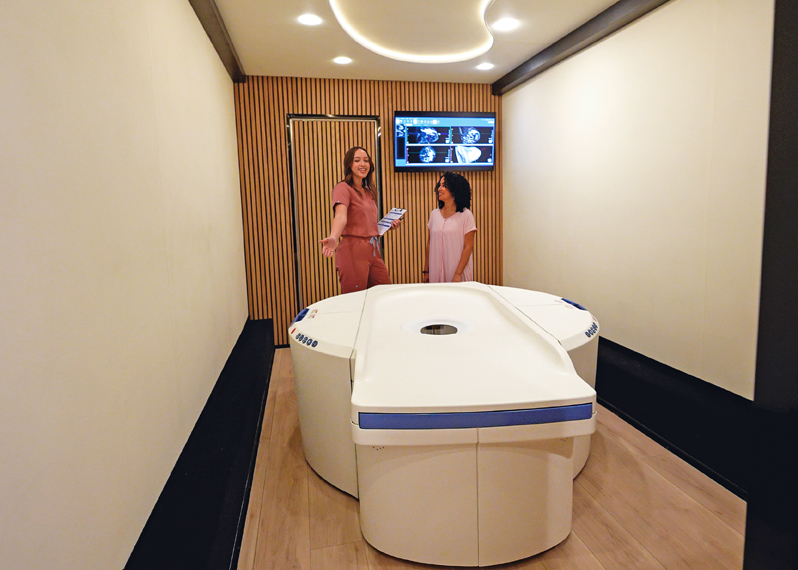
Dedicated breast CT (DBCT) is a new diagnostic breast imaging modality that produces true 3D images of the uncompressed breast and addresses known limitations of traditional mammography. By eliminating tissue overlap, DBCT allows radiologists to evaluate breast anatomy with greater clarity than 2D mammography, particularly in patients with dense breast tissue, breast implants, or compression intolerance.
In many healthcare systems, additional imaging is often introduced only after an inconclusive mammogram rather than as part of a clearly defined, proactive protocol. Access may hinge on provider discretion, insurance approval, or a patient’s ability to advocate for additional testing.
“Too often, patients have to push for clearer answers instead of being guided toward them,” said Dr. Safedin Beqaj, Clinical Laboratory Director for TruArc Health and a clinical advisor for Gnosis for Her. “Patients should not carry the responsibility of navigating these gaps on their own. They deserve real support.”
Beyond detection: Reducing diagnostic uncertainty
Improving imaging clarity serves two important purposes: identifying cancer earlier and limiting unnecessary alarm. Screening should provide answers, rather than prolong diagnostic uncertainty.
When imaging results are ambiguous, the impact extends far beyond the initial appointment.
The cascade effect of ambiguous findings
An inconclusive result often triggers a cascade of follow-up care. Patients may return for additional imaging, and biopsy recommendations can follow, even when final pathology reveals benign findings.
Referrals to breast specialists introduce further appointments and potential delays. Insurance authorization requirements may add administrative hurdles and financial concerns.
Each step may be clinically appropriate, yet together they lengthen the timeline and intensify emotional strain. What begins as a routine screening can extend into weeks or months of diagnostic testing.
Research shows that women with an abnormal screening mammogram may wait about 13 days on average from the initial exam to follow-up imaging, with some waiting even longer depending on local processes and scheduling delays.
Other studies report that when a biopsy is recommended after diagnostic imaging, the median time from diagnostic evaluation to biopsy can be around three weeks (about 21 days).
These intervals are significant, especially when patients are left navigating uncertainty about their health while juggling daily life, work, and caregiving responsibilities.
When diagnostic pathways improve, the benefits extend beyond individual patients. Effective breast cancer screening touches workplaces, families, public health systems, and local economies.
When imaging is clearer and follow-up is more structured, the impact extends well beyond the individual patient.
Earlier treatment, better outcomes
Shorter time-to-answer allows treatment to begin sooner when cancer is detected. Earlier-stage diagnoses are typically associated with less aggressive interventions and stronger survival outcomes.
In fact, according to the American Cancer Society, the five-year relative survival rate for localized breast cancer is about 99%, compared to approximately 32% when the cancer has spread to distant organs. This illustrates how strongly outcomes depend on stage at diagnosis.
Communities benefit when disease is caught earlier rather than later. The ripple effects include improved long-term health outcomes and greater stability for families dealing with a diagnosis.
Lower system-wide healthcare costs
Repeated callbacks, unnecessary biopsies, and extended surveillance all carry financial implications. While follow-up care is sometimes appropriate, clearer initial imaging can reduce avoidable procedures and redundant testing.
Over time, fewer unnecessary interventions can lower cumulative healthcare expenditures for both patients and systems. In a resource-constrained healthcare system, efficiency supports sustainability.
Strengthened trust in preventive care
Public health thrives when preventive care feels reliable and transparent. When patients perceive screening as confusing or inconsistent, confidence erodes.
“If screening feels opaque or inconsistent,” Dr. Baqaj said, “participation drops. That’s a problem.”
Communities already grappling with medical mistrust cannot afford additional ambiguity. Clear communication, structured pathways, and visible accountability help reinforce trust in screening programs and encourage sustained participation.
The role of education
A major challenge in breast density education is how little many women know about their own breast density status.
In one survey, only about 20% of women knew that dense breasts reduce the sensitivity of mammography for detecting tumors, and even fewer understood that density itself increases cancer risk.
While most states now require density notification letters, these communications are frequently technical and brief. Patients may not fully understand:
- What density means
- How it affects detection
- Whether supplemental imaging is appropriate
- What next steps are available
Clear education from clinicians and imaging providers is essential. When patients understand their risk profile, they can participate more actively in shared decision-making.
Integrating technology responsibly
Innovative imaging technologies continue to become available. Advances in diagnostic imaging, including artificial intelligence and dedicated breast CT, are improving how radiologists visualize and evaluate breast tissue.
Technology alone cannot solve the pathway problem. Integration depends on clear referral protocols, alignment with insurance coverage policies, thorough provider training, transparent data practices, and consistent outcome monitoring.
Imaging advances and system coordination must move in parallel to improve detection at scale.
A turning point in screening conversations
The good news is that the conversation around breast density is evolving. Legislation has improved notification transparency. Research continues to refine supplemental imaging protocols. Advocacy groups are amplifying awareness.
TL;DR: What needs to change
Moving the conversation forward requires practical changes in how breast density is addressed within breast imaging pathways, including broader adoption of innovative imaging modalities such as dedicated breast CT in dense breast tissue.
- Center breast density in screening guidelines
Breast density should be incorporated as a primary imaging variable within national and clinical screening guidelines and protocols. Instead of appearing as a brief notation on a report, density should directly inform imaging recommendations, follow-up intervals, and supplemental testing pathways.
When breast density is treated as a key clinical factor, imaging strategies can better account for how dense tissue affects cancer detection.
- Expand access to supplemental imaging
Dedicated breast CT, MRI, ultrasound, and contrast-enhanced mammography should be incorporated into structured diagnostic pathways for patients who require clearer evaluation. Availability should not hinge on geography, insurance hurdles, or a patient’s ability to advocate for herself.
Establishing standardized eligibility criteria and insurance coverage standards can help reduce disparities in access to advanced imaging.
- Normalize risk-based conversations
Risk-based screening discussions should become routine rather than occasional. Patients deserve clear, proactive conversations about how breast density affects detection and what imaging options are appropriate for them.
When clinicians openly address breast density as part of early detection discussions, patients are better positioned to make informed decisions.
A smarter path for breast cancer screening
Traditional mammography remains indispensable. It has saved countless lives and continues to do so. However, acknowledging its limitations in dense breast tissue is a key step in refining this process.
Dense breast tissue affects millions of women. The science is clear. Advanced imaging technologies now exist to evaluate breast tissue with greater clarity.
What remains is the commitment to place this common high-risk factor where it belongs: at the center of the imaging conversation.
By Dr. Margaret Bredehoft, chief development officer at Gnosis for Her.